
The 2025 breeding season at Montrose
The 2025 Piping Plover breeding season at Montrose would have easily gone down as one of our best seasons, had it not been for tragedy striking at the very end.
Pippin, the 2023 Cat Island, WI hatch, returned first, on April 11, eager to claim a territory at Montrose. Pippin had spent the prior breeding season at Montrose, waiting for a mate, that never materialized. He was joined by “Uncle Larry,” a charming 2-yr old who, like Pippin, had spent his 2024 season as a bachelor. He hung around a nest and chicks in Michigan, earning him the uncle title.
Pippin’s rule over Montrose was short-lived. Four-year old Chicago native son Imani returned on April 18 and the two were soon observed drawing imaginary lines in the sand by walking parallel to each other, endlessly, hour after hour and day after day.
Searocket, the captive-reared Piping Plover released at Montrose in 2023, filled many a heart with joy upon her return on May 9. She had bred with Imani in 2024 and we were hoping for another nest this year. We knew Pippin had a spot for her in his heart and we were curious whether she would make a different choice of mate this year. She never hesitated, however, immediately affirming Imani as her preferred mate. Courtship and mating ensued, and by the second half of May we had 4 beautiful eggs in a nest in the west panne areas of the dunes. What a relief it was that they selected a location further away from the shoreline than they had in 2024! We were not eager to relive the drama of the 2024 season, when the nest was too close to the lake and at risk of being washed away by waves or blown by wind more than once.
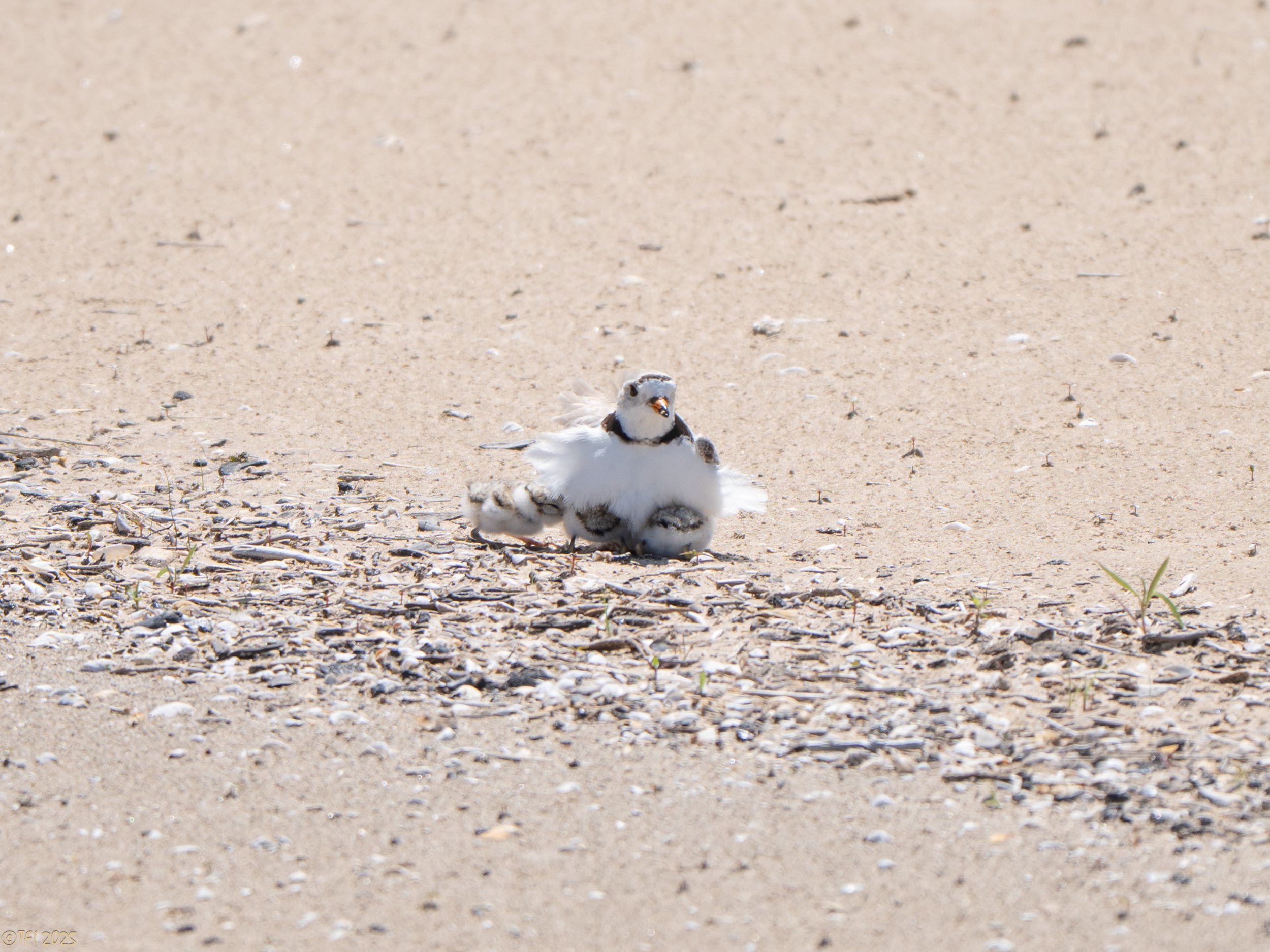
The nesting period unfolded rather smoothly, Searocket and Imani taking turns incubating the eggs. Our fabulous team of nearly 120 volunteers stood watch daily, from 6 am to 8 pm and beyond, in sun, wind, rain, cold and heat, to make sure the nest and plovers stayed safe. In the early morning a few weeks later, the eggs started hatching and we had three precious chicks making their first steps inside and outside the exclosure. The fourth egg did not hatch.
Soon, the parents took their chicks to the pier inlet, where they must have determined the feeding was better. The chicks thrived, gaining weight under our watchful eyes, and giving fantastic views to the many adoring fan who came to visit. The Great Lakes team made a trip to Chicago to band the little ones, their orange band being adorned by a star in lieu of the customary Great Lakes dot, in recognition of the Chicago flag and the strong support of the Chicago community. As has been our practice, we ran a naming contest, and the chicks transformed into Bean (green star), El (red star) and Ferris (blue star), honoring Chicago landmarks.
Searocket soon took off to her wintering grounds. The females typically leave before the males, likely eager to recover from the energy cost of laying 4 eggs (sometimes 8, if there is a failed nest) and prepare for the next season. Imani stuck around, doting on his chicks, teaching them how to fend for themselves. When it was time for the chicks to learn how to fly, he would stand at the shoreline, piping to them, until they came running to him. He would then take off, fligh north over the lake and pier, then turn around and come back to the beach. Bean and El followed readily, Ferris was a bit more hesitant.
The day came toward the end of July when it was time for Imani to leave. In the evening, he circled the beach one more time, flew higher and higher, piping, then headed south! Mission accomplished for the year!
Sadly, tragedy struck soon thereafter. On a lovely day a few days after Imani’s departure, Bean had encouraged Ferris to fly with him over the lake. Ferris then returned to his favorite feeding area, the pier inlet, and Bean and El took off and flew south. We would later spot them at 63rd St beach. Ferris continued feeding in the pier inlet, unaware of the Red-tailed Hawk that had landed in the nearby cottonwood trees. The hawk saw an opportunity and took Ferris and his precious life. Ferris was a huge loss to our monitor and fan communities, who loved his independent spirit and frequent presence at the pier inlet.
Bean and El lingered at 63rd st beach and got to meet Ray, one of the captive-reared chicks released in 2025 in Waukegan. By the end of August, they had left for their wintering grounds.
Pippin remained a bachelor for a second breeding season, spending time at both Montrose and Waukegan. Unfortunately, in mid-July, his right foot got tangled in artificial hair while he was at Waukegan, likely from a hair extension. The hair strangled Pippin's right foot significantly. With Fish and Wildlife Service, a field biologist from the Forest Preserves of Cook County, a vet resident from the Brookfield Zoo, and several monitors, we tried to trap him multiple times over the span of an afternoon at Montrose, without success. He left for his wintering grounds before we had another opportunity to try and catch him. (In 2026, he returned, alive, but missing a part of his right foot. He can walk, run and fly fine).
This season, Monty's father YOGi, and his mate bLO made history once again at Silver Lake State Park in Michigan. Last year, bLO stopped by Silver Lake State Park after nesting further north in MI and fledging 2 chicks. Finding YOGi's advances irresistible, she nested a SECOND TIME in 2024 and they fledged 2 chicks.
This year, bLO decided to forego her other mate in MI and she went straight back to Silver Lake State Park and YOGi. They nested early and fledged 2 chicks in late June. So what's an overachieving pair to do? They nested again! On July 30 one of bLo and YOGi's eggs from the second brood hatched and they have a new chick. bLO is now on her way south and we wish YOGi the best in fledging another half-brother or sister for Monty, and technically another aunt or uncle for Imani.
We are often asked where Searocket, Imani, Pippin, Bean and El spent their winter. We don’t know! Maybe because of the intense scrutiny they experience at Montrose, they select areas that are remote, quiet and without many people around. Searocket, Imani and Pippin have not been spotted on wintering grounds in all the years they have been traveling back and forth.